
Dad, I Just Created JavaScript.
My ten-year-old sat down with an AI agent, zero coding experience, and a problem he wanted to solve. Five hours later, he’d built a working chess game. Then he asked me a question I wasn’t ready for.

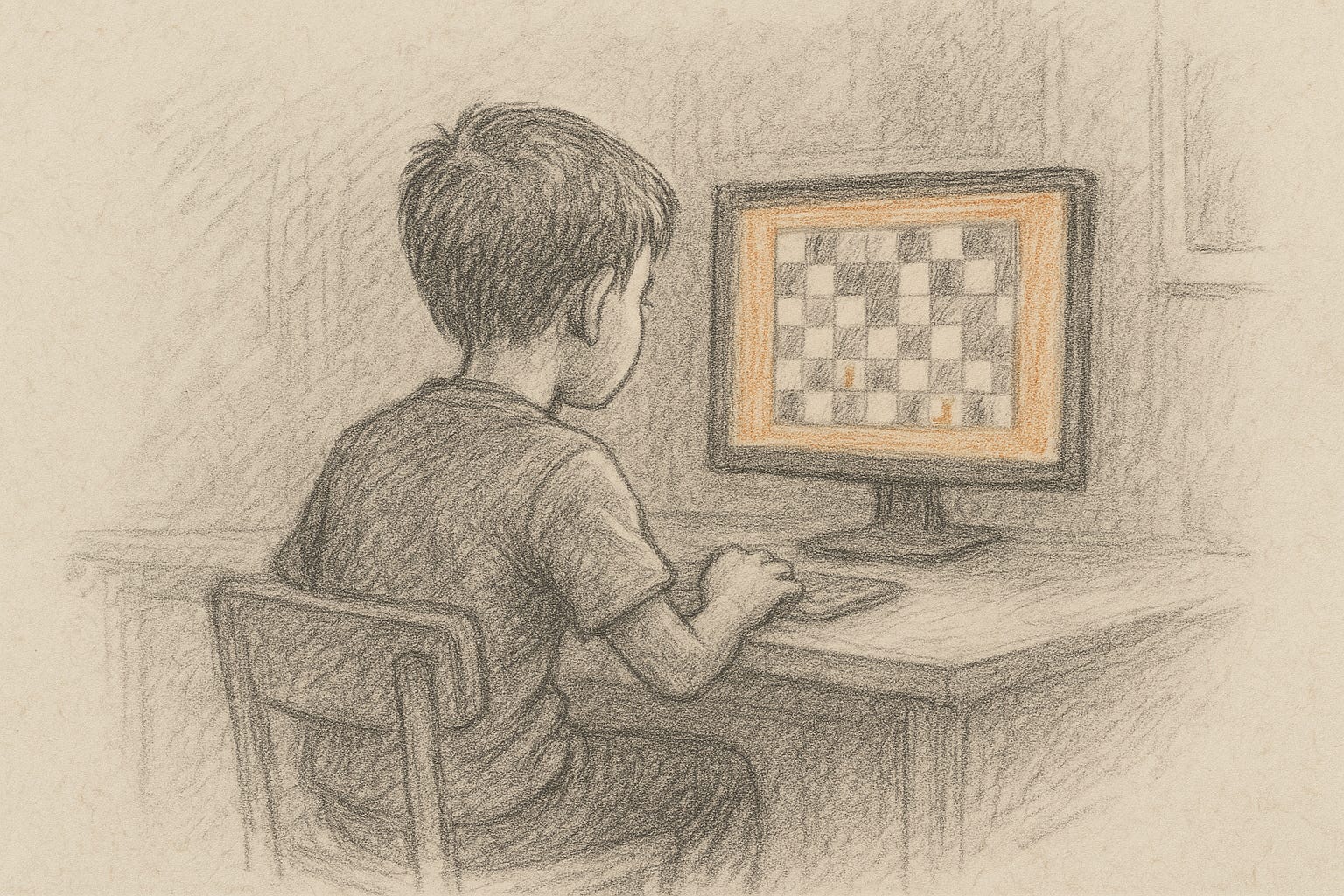
My son is ten. He’s in fifth grade. He’s passionate about karate, school, Pokémon, and games. He’s an incredible big brother to his little sister. His relationship with technology is limited to tablets, a gaming console, and a Chromebook at school. He knows I work with AI, but his exposure is pretty thin: talking to ChatGPT every once in a while, asking Amazon’s Alexa a question.
I asked him if he’d be willing to help me with an experiment. Sit down with an AI agent for an hour and try to build anything he wanted on the computer. He said yes, then asked me what he should build.
I turned the question back to him. “I don’t know what would be cool. What’s a problem you have that you’d like to solve?”
He thought about it for a second and said something about a Pokémon encyclopedia. With over 1,000 characters and all their attributes, he could never keep them straight. That sounded like a real problem with a real solution. We left it there.
Setting the Table
I sat him down in front of a Mac Mini running Claude Code, Anthropic’s AI coding agent. The project folder was empty except for a single instruction file I’d written for the AI. It said, roughly: The user is a ten-year-old with zero coding experience. Help him dream, plan, and build. Keep it simple. Celebrate the effort. And keep a log of everything so I can see what happened.
That was it. I didn’t give my son a tutorial. I didn’t explain what JavaScript was. I didn’t hover. I handed him a tool and a blank canvas and walked away.
Ninety Minutes of Planning (Without Any Help)
Here’s the part that surprised me first: he didn’t ask me for anything.
For about an hour and a half, he worked with the AI agent on designing what he wanted to build. The Pokémon encyclopedia idea had evolved into something bigger: a chess game where every piece is a Pokémon. Different regions of the Pokémon universe would assign different characters to the chess pieces. Legendaries would be queens. Heavy Pokémon would be rooks. Both sides would use the same team, but one side would use shiny sprites.
I could hear him talking to the screen from the other room, not struggling, just thinking out loud the way kids do when they’re genuinely engaged. The AI was walking him through the planning process: what should the game look like? What happens when you click a piece? What’s the most important thing to build first?
He never came to me. Not once.
“I Can’t Believe This Is Real”
The first time he got up from the desk was when the AI asked for permission to open a Chrome browser. I told him he could approve it. A few seconds later, he appeared in the doorway with a look on his face I’ll remember for a long time.
“Dad, I can’t believe that this is real. I just created JavaScript and I don’t know anything about that.”
He was looking at a working chess board in the browser. Pokémon sprites on every square. His design, his decisions, running in a real web browser.
Then he said something that stopped me cold.
“I feel like this is going to change a lot of people’s jobs. What will they do? How will they afford to eat and things like that?”
He’s ten.
Horses and Automobiles
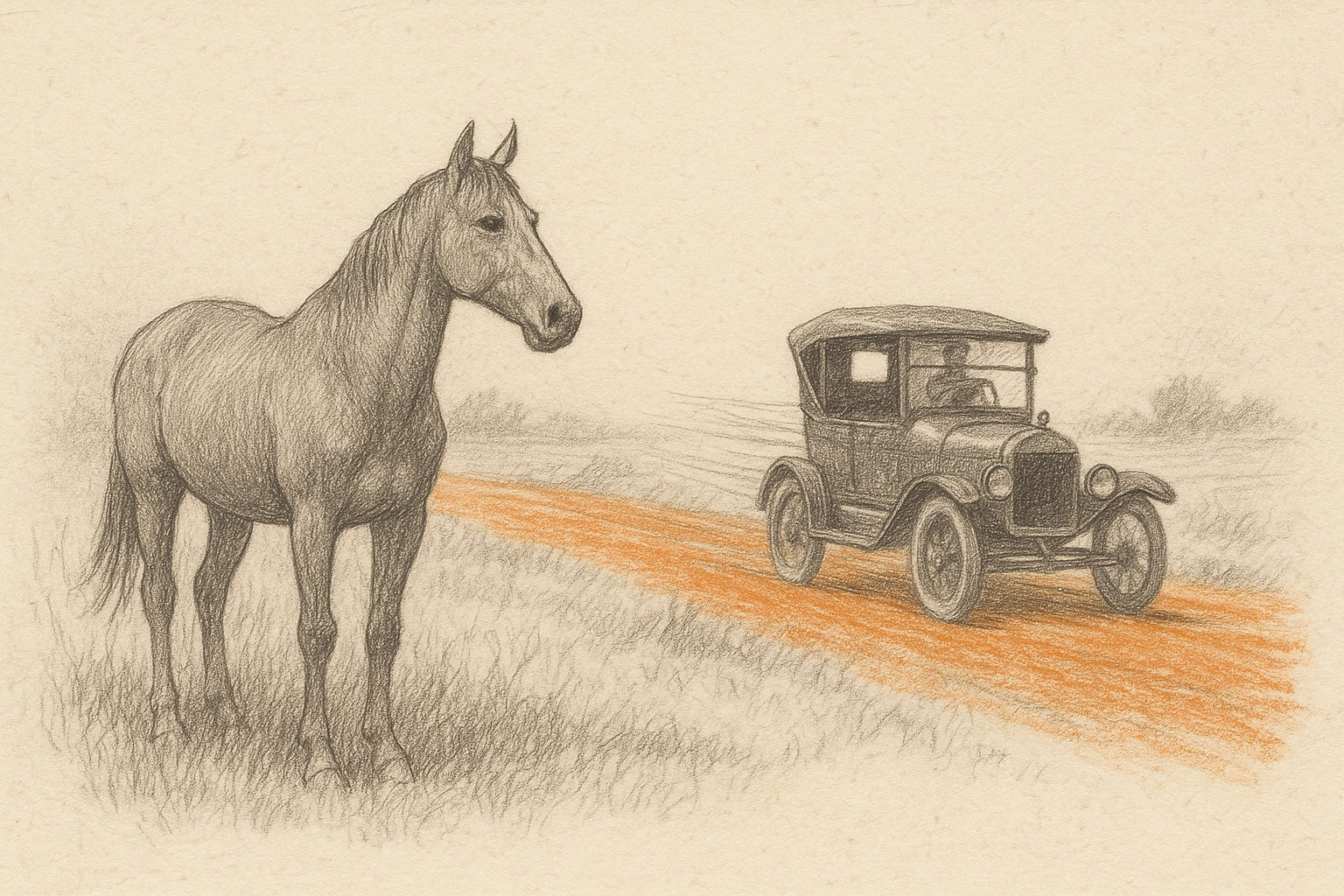
I told him the world is definitely changing, and that his instinct was right. Then I gave him the example I’ve given adults who ask me the same question.
When automobiles started becoming commonplace, entire industries existed around horses: breeders, farriers, stable hands, saddle makers, feed suppliers, carriage builders. Those people looked at the car and saw the end of their livelihood. And they weren’t wrong, exactly. Their specific jobs did go away.
But the world that replaced it needed mechanics, gas station operators, road builders, driving instructors, auto insurance adjusters, traffic engineers, and eventually everyone from NASCAR pit crews to Uber drivers. The work changed shape. It didn’t disappear.
My friend Jared, hearing the story later, suggested I have my son Google “post-labor economics.” I’m not holding my breath on that one.
Three and a Half More Hours
What I expected was that my son would see the working chess board, feel satisfied, and move on. He’s ten. His attention span is not infinite.
What actually happened is that he spent the next three and a half hours testing, refining, polishing, and adding features. No one told him to. No one was standing over him with a checklist.
He added a rules section. He built a rotating display of Pokémon facts and quotes that changes every time the page loads. He figured out that the game should let you choose from nine different Pokémon regions (Kanto through Paldea), each automatically assigning the right Pokémon to the right chess pieces. He added sound effects: the actual Pokémon cry for each character, triggered when the piece moves on the board.
He asked the AI for three difficulty levels. Easy mode makes random legal moves. Medium evaluates all legal moves and prioritizes captures. Hard runs a full search algorithm that looks three moves deep to find the best possible play. He also wanted the option to play against a friend.
Under the hood, the code uses concepts he’s never heard of and probably couldn’t name: event listeners, API calls, search algorithms, state management. He doesn’t need to know what they’re called. He knows what they do because he told the AI what he wanted and watched it work.
When he was done, the game was deployed to the web. You can play it right now at chess.mceachen.site.
What I Observed (Not What I Taught)
I want to be clear about something: I didn’t teach my son anything that day. I set up the environment, answered one permission question, and had a conversation about horses and cars. Everything else happened between him and the AI.
Here’s what I noticed from the outside:
He planned before he built. The AI walked him through dreaming, then planning, then building, then polishing. He spent ninety minutes on the first two phases before a single line of code was written. That’s not how most adults approach a new project, let alone a ten-year-old.
He made real decisions. The journey log is full of choices he made: dark blue background (after experimenting with gradients and region maps and rejecting them all), three difficulty levels instead of two, pawn promotion that lets you choose the piece instead of auto-queening. These are design decisions. He was the product owner.
He identified bugs. At one point, switching regions was resetting his custom team picks. He noticed it, described the problem clearly, and the AI fixed it. He was doing QA without knowing the term.
He asked a question about costs. When the AI opponent was being built, he raised a concern about whether the computer thinking would cost money (I had mentioned to him that LLM interactions cost money). The AI explained that it was all local math, no API calls. A ten-year-old, unprompted, thinking about operational costs.
He didn’t just accept what was built. He kept iterating. He kept pushing. Three and a half hours of polishing is not the behavior of someone who is passively consuming. That’s the behavior of someone who owns what they’re building.
The Question That Matters
The technical achievement is impressive. A ten-year-old with no coding experience built a playable chess game with AI opponents, sound effects, nine themed regions, and over a thousand Pokémon characters to choose from. It’s live on the internet (for the record, I managed the deployment to the web… but I didn’t change a single character of his code).
But the technical achievement is not the point.
The point is the question he asked standing in my doorway. The one about people’s jobs. About how they’ll eat.
He didn’t ask it because someone told him to worry about AI. He asked it because he experienced, firsthand, what it feels like to create something complex without having the underlying skills. And his immediate instinct was empathy. Not “this is cool” (though he clearly thought it was). His first reaction was concern for other people.
I’ve sat in rooms full of executives discussing AI strategy. I’ve read the white papers and the thought pieces and the LinkedIn posts. I’ve heard every version of “AI won’t replace you, but someone using AI will.” Most of those conversations happen in the abstract. They’re about market dynamics and competitive advantage and workforce transformation.
My son made it concrete in ten seconds.
What I Actually Think
I don’t know what the labor market looks like in fifteen years. Nobody does. But I watched something happen that I think matters.
The gap between “having an idea” and “making it real” just collapsed. Not narrowed. Collapsed. My son went from “I want a Pokémon chess game” to a working, deployed application in a single afternoon. He didn’t learn to code. He learned to build. Those are different things.
The skills that mattered were the ones he already had: the ability to describe what he wanted, the taste to know when something wasn’t right, the persistence to keep pushing, and the empathy to wonder what it all meant.
I don’t think those skills are going away. I think they’re about to matter more than they ever have.
Try It
The game is live at chess.mceachen.site. Pick a region. Choose your team. Turn the sound on.
A ten-year-old built that.
If this resonated with you, consider subscribing to Earned in the Fire. I write about operations, AI, and what I’m learning the hard way.